
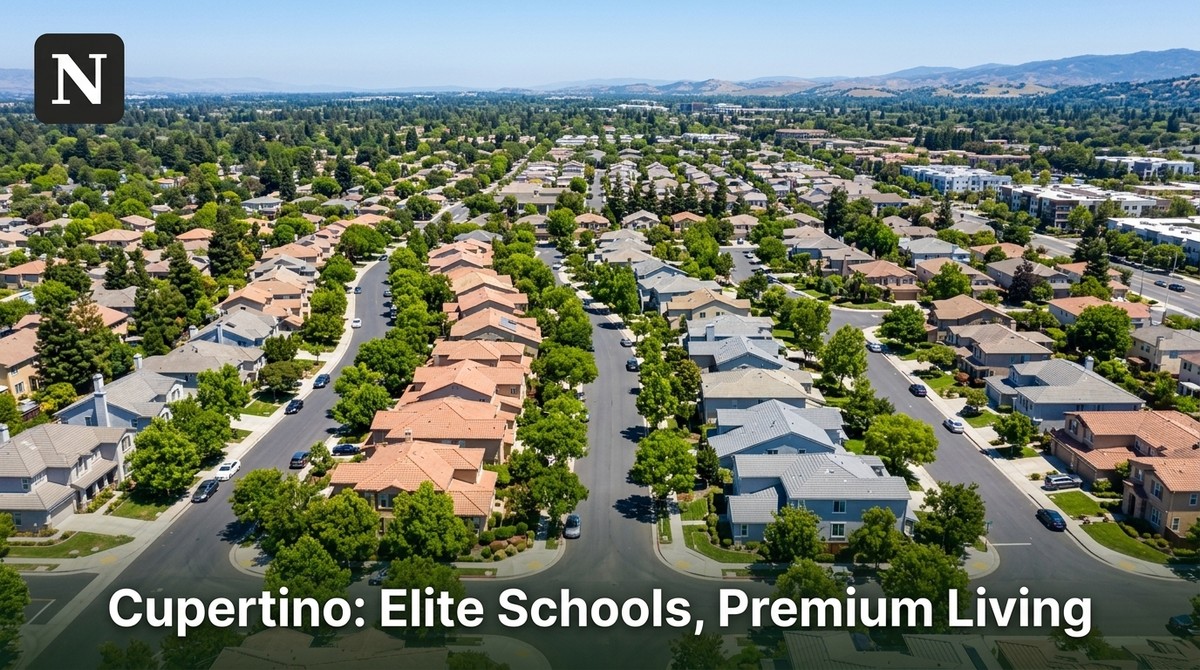
Cupertino Neighborhood Guide
We present this comprehensive Cupertino neighborhood guide to dissect the underlying mechanics of one of Silicon Valley’s most competitive housing markets. Driven by elite public schools and proximity to major tech campuses, Cupertino operates under strict inventory constraints. Buyers entering this market must understand the financial metrics dictating property values to execute a successful acquisition.
The South Bay real estate landscape is defined by hyper-local demand curves, and Cupertino stands as a prime example of localized premium pricing. Homebuyers frequently evaluate this region based on yield, analyzing both educational access and long-term equity retention. We track these specific variables to provide clarity on where capital is best deployed.
Our analysis strips away the noise of national real estate trends to focus exclusively on local data. By examining absorption rates, pricing per square foot, and neighborhood-specific amenities, we provide a structural overview of what drives the Cupertino housing sector. This analytical approach ensures that buyers and sellers make informed, data-backed decisions.
Table of Contents
- Cupertino Housing Market Dynamics
- How Schools Drive Cupertino Demand
- Commute and Walkability Metrics
- Analyzing Cupertino By Pocket
- Who This Cupertino Market Fits
- FAQs: Cupertino Neighborhood Guide
Cupertino Housing Market Dynamics
To understand Cupertino, one must first analyze the unique financial mechanisms supporting its property values. While national headlines often suggest a cooling housing market, Cupertino demonstrates strong absorption rates fueled by concentrated corporate compensation. Buyers in this market routinely leverage restricted stock units and performance bonuses to fund substantial down payments, insulating the local sector from broader interest rate fluctuations.
The entry-level threshold for a single-family home in Cupertino currently sits well above the broader Santa Clara County median. A standard mid-century ranch home requires significant capital, often starting around the 2.5 million dollar mark, depending on exact location and condition. Buyers seeking newly constructed or fully renovated properties must prepare for valuations exceeding 4 million dollars, reflecting the high cost of local construction and stringent zoning laws.
Inventory constraints remain the primary catalyst for these sustained high valuations. Long-term homeowners rarely relinquish their properties without a compelling financial reason, resulting in a persistent supply shortage. You can review our Silicon Valley housing market update to see how these low inventory levels compare across neighboring municipalities.
Furthermore, the impact of RSUs and employment trends cannot be overstated when mapping Cupertino demand. The liquidity events of major technology firms directly correlate with spikes in competitive bidding within the city borders. We consistently observe multiple-offer scenarios on properties that are priced accurately and presented without deferred maintenance.
How Schools Drive Cupertino Demand
The public education infrastructure is the foundational pillar of Cupertino real estate values. The Cupertino Union School District and the Fremont Union High School District consistently rank among the highest performing districts in the state. This academic reputation creates a highly inelastic demand curve, where buyers are willing to pay a documented premium for specific attendance boundaries.
It is critical to note that municipal boundaries do not perfectly align with school district boundaries. Certain parcels located physically within San Jose city limits are zoned for Cupertino schools, thereby commanding a Cupertino-equivalent pricing premium. Conversely, minor pockets within Cupertino may fall into different districts, which directly alters their market valuation and buyer pool.
Monta Vista High School serves as a prime example of hyper-local pricing mechanics. Properties verified to be within the Monta Vista attendance zone frequently exhibit higher per-square-foot valuations and shorter days on market compared to adjacent neighborhoods. Buyers treat these specific homes as equity shelters, banking on the historical resilience of top-tier school zoning.
For buyers prioritizing educational access, verifying the exact address with the school district is a mandatory phase of due diligence. Boundary lines can shift, and relying on outdated maps can lead to costly miscalculations. We strongly advise cross-referencing all parcel data with official district registrars before submitting a formal offer.
Commute and Walkability Metrics
Cupertino is geographically positioned at the foothills of the Santa Cruz Mountains, offering a strategic advantage for specific technology commutes. The presence of Apple Park and the original Infinite Loop campus dictates local traffic patterns and heavily influences housing desirability. Employees seeking a minimal commute frequently target properties within a two-mile radius of these corporate hubs.
While Cupertino is predominantly a suburban environment, specific corridors offer measurable walkability. The intersections along Stevens Creek Boulevard and De Anza Boulevard feature concentrated retail, dining, and grocery options. However, buyers should not expect dense, urban walkability; the city is fundamentally designed around automotive transit and established single-family subdivisions.
Access to major arterial highways, specifically Interstate 280 and State Route 85, provides efficient routing to other Silicon Valley employment centers. The strategic placement of these interchanges allows residents to navigate to Palo Alto, Mountain View, or North San Jose with relative ease during non-peak hours. Buyers must evaluate the proximity of a property to these highways, balancing easy access against potential noise pollution.
Analyzing Cupertino By Pocket
West Cupertino Inventory
The western edge of Cupertino, stretching toward the foothills, contains some of the most premium housing stock in the city. Properties in this sector often feature larger lot sizes, mature heritage oaks, and occasionally, sweeping views of the Santa Clara Valley. The zoning here generally supports significant square footage expansions, making it a primary target for custom rebuilds.
Neighborhoods like Seven Springs offer a master-planned community feel with integrated amenities, which is a rarity in the older suburban tracts of the South Bay. Inventory in West Cupertino turns over slowly, and buyers must be prepared for aggressive competition when a well-maintained estate hits the market. The premium paid in this pocket is directly tied to the combination of privacy, lot utility, and Monta Vista High School zoning.
South Cupertino Properties
South Cupertino provides a transitional market blending into the neighboring Saratoga luxury living sector. This area features a mix of traditional 1960s ranch homes and substantially remodeled modern properties. The lot sizes typically average around 8,000 to 10,000 square feet, providing adequate space for backyard amenities or accessory dwelling units.
School boundaries in South Cupertino can become complex, with some parcels feeding into different high schools depending on the exact street. Buyers targeting this area must maintain a strict analytical focus on the specific educational zoning of each target property. The proximity to Saratoga also influences architectural trends, with many homeowners investing heavily in high-end exterior renovations.
East Cupertino Development
East Cupertino borders San Jose and Santa Clara, presenting a denser housing environment. This pocket includes a higher concentration of townhomes, condominiums, and smaller single-family lots. For buyers seeking entry into the Cupertino market at a slightly lower price point, the eastern neighborhoods offer the most viable options.
The Rancho Rinconada neighborhood is a notable subdivision within this eastern sector, historically known for its smaller original footprint homes. Over the past decade, we have tracked a massive wave of redevelopment in this specific tract, with original structures being razed to build maximized two-story residences. This transformation highlights the aggressive deployment of capital to secure Cupertino land value.
Who This Cupertino Market Fits
The Cupertino real estate market is tailored for the analytical, data-driven buyer who views homeownership as a strategic asset allocation. It perfectly suits technology professionals optimizing for proximity to core engineering campuses while securing access to elite public education. These buyers typically possess high liquidity and understand the necessity of moving decisively in a constrained inventory environment.
This market does not cater well to buyers seeking vast rural acreage, highly walkable urban nightlife, or entry-level bargain pricing. The floor for entry is established by the baseline land value, which remains exceptionally high regardless of the physical structure’s condition. Buyers must adjust their expectations regarding square footage and lot size when comparing Cupertino to peripheral Bay Area cities.
Ultimately, purchasing in Cupertino requires a long-term holding strategy to maximize the return on investment. The historical data proves that holding property in this localized sector provides a strong hedge against broader economic volatility. Clients who map out their strategic real estate moves with a five to ten year horizon consistently capture the most equity growth.
FAQs: Cupertino Neighborhood Guide
What is the baseline entry price for a single-family home in Cupertino?
As of recent data, the baseline entry point for a single-family residence typically hovers around 2.5 million dollars. This figure secures a largely original, unrenovated property requiring modernization. Fully remodeled homes or new construction projects demand significantly higher capital, often clearing the 3.5 to 4 million dollar threshold.
Do all properties with a Cupertino mailing address fall into the Cupertino Union School District?
No, municipal mailing addresses do not guarantee placement in the Cupertino Union School District. District boundaries are drawn independently of city limits, meaning some Cupertino homes attend different schools, while some San Jose homes are zoned for Cupertino schools. Strict verification of parcel data is a mandatory step for any buyer.
Is Cupertino considered a walkable city?
Cupertino is fundamentally a suburban, automobile-centric municipality. While specific commercial corridors along Stevens Creek Boulevard offer clustered amenities, the vast majority of residential neighborhoods require a vehicle for daily errands. The city does provide extensive cycling infrastructure, which is heavily utilized by local commuters.
How does proximity to major tech campuses affect local property values?
Proximity to corporate hubs like Apple Park establishes a measurable pricing floor for surrounding neighborhoods. Properties within a tight commuter radius experience lower days on market and higher retention of value during economic shifts. The convenience factor of a sub-ten-minute commute is a premium that tech-sector buyers are consistently willing to finance.
Posted on August 29, 2026 by The Norcia Team in Uncategorized
← Back to Blog