
Santa Clara County Probate vs Trust Property Sales
The transfer of generational wealth in Silicon Valley requires strict adherence to legal frameworks that dictate how real estate assets are managed and liquidated. When families inherit property in Santa Clara County, understanding the mechanics of probate vs trust is the critical first step before initiating any market activity. We observe that the specific legal vehicle housing the property governs the timeline, the preparation strategy, and ultimately the absorption rate of the asset. The Norcia Team relies on decades of tracking South Bay market metrics to guide administrators and trustees through these rigid processes.
Identifying Your Path: Probate vs Trust
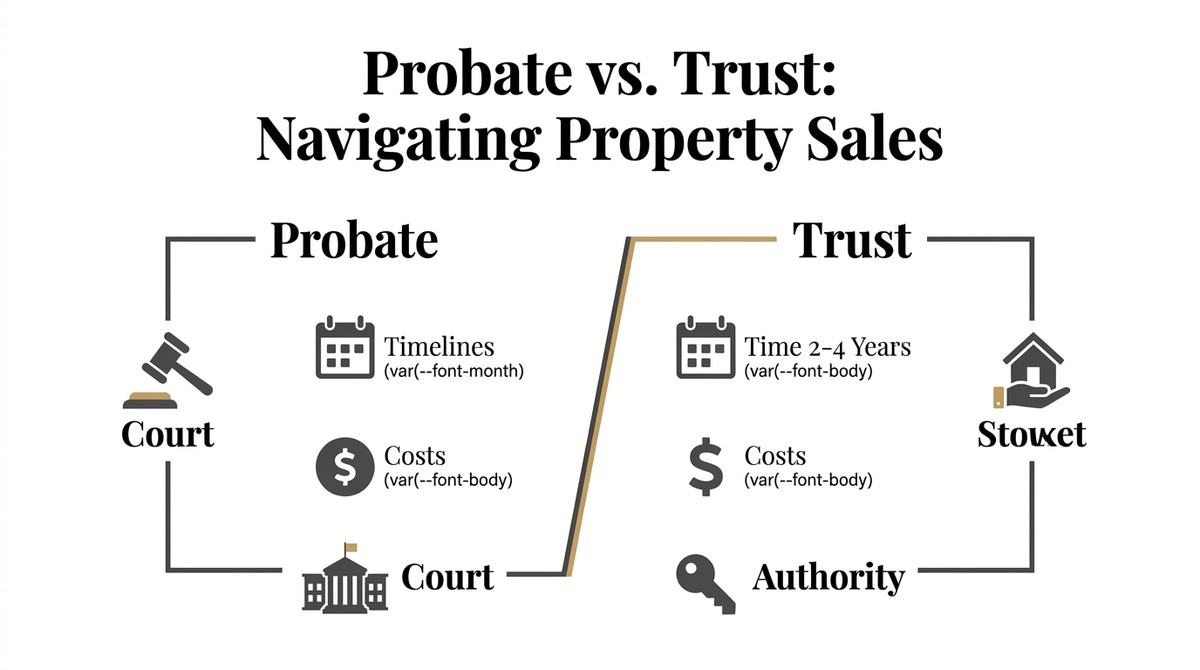
Determining whether an asset is subject to probate or governed by a living trust hinges on how the title was held at the time of passing. If a homeowner dies intestate or with only a standard will, the property generally enters the probate system, requiring a judge to validate the transition of assets. Conversely, properties properly deeded into a living trust bypass the court system entirely, granting immediate authority to the designated successor trustee. Identifying which individual holds the legal authority to sign listing agreements and disclosures is a prerequisite to analyzing local housing inventory data and formulating a pricing strategy.
In a probate scenario, the court appoints an executor or administrator, and their authority is either granted with full or limited powers under the Independent Administration of Estates Act. Those with limited authority face stringent court oversight, including mandatory hearings to confirm the final sale price and the potential for public overbidding on the courtroom floor. Trustee sales operate with far greater autonomy, allowing the trustee to sign all necessary documents without judicial approval. We consistently see that avoiding court bottlenecks allows for highly precise market timing, especially when navigating volatile tech-driven wealth dynamics in the South Bay.
Timelines and Market Absorption Realities
The timeline discrepancy between these two legal paths fundamentally alters how we approach market absorption and pricing mechanics. Probate cases in Santa Clara County currently average twelve to eighteen months from the initial filing to the final distribution of assets. This extended holding period exposes the estate to fluctuating interest rates and shifting inventory constraints, making it impossible to time the market with any real precision. Furthermore, properties sitting vacant during a prolonged court process often suffer deferred maintenance, compounding the difficulty of securing premium pricing when the asset finally hits the open market.
Trust administration presents a stark contrast in velocity and strategic flexibility. Once the successor trustee provides the death certificate and the affidavit of death of trustee, the property is immediately prepared for active listing. This allows the estate to capitalize on optimal selling windows, such as the spring tech-vesting season when RSU liquidity drives buyer demand. For instance, we recently executed an accelerated trust sale timeline that minimized holding costs and secured a premium valuation simply by moving faster than competing neighborhood inventory.
Cost Analysis and Equity Preservation
Protecting the financial equity of an inherited property requires a clinical analysis of the fees associated with both legal processes. Probate is notoriously expensive, as California law sets statutory fees for both the estate attorney and the executor based on the gross value of the asset. For a median-priced single-family home in San Jose, these statutory fees strip tens of thousands of dollars from the final net proceeds, ignoring any existing mortgage debt in the calculation. These mandatory costs dilute the generational wealth that the property was intended to preserve.
Alternatively, the financial mechanics of a trust sale are highly efficient and predictable. While attorneys and accountants still bill for their administrative guidance, these professionals typically charge an hourly rate rather than a statutory percentage of the gross asset value. The absence of court filing fees, mandatory probate referee appraisals, and prolonged carrying costs significantly bolsters the net equity realized by the beneficiaries. We emphasize that structuring seamless property transitions through a trust is the most effective method for shielding South Bay real estate equity from unnecessary administrative erosion.
How the Legal Path Impacts Sale Price
The legal status of an estate property directly influences buyer perception and the final negotiated valuation. Properties sold through probate, particularly those requiring court confirmation, often carry a stigma of distress or bureaucratic complication. Buyers and their agents know that limited authority probate sales require transactions without standard contingencies, which naturally depresses the initial offer price as buyers price in the risk of the unknown. Furthermore, the mandatory deposit rules and the risk of being outbid at the court confirmation hearing deter many traditional retail buyers from participating entirely.
Trust sales function almost identically to standard equity sales from the perspective of the buyer. The trustee has the authority to authorize repairs, stage the home, and offer standard inspection contingencies, which drastically increases the buyer pool and fosters competitive bidding environments. By optimizing property preparations for maximum return, trustees leverage current market inventory constraints to drive the final price upward. We track this data closely, and fully prepped trust sales consistently yield higher price per square foot metrics than their probate counterparts in the exact same neighborhoods.
Strategic Property Preparation Dynamics
Preparing an inherited home for the market requires capital allocation, and the legal path dictates how and when those funds are deployed. In a trust scenario, the trustee usually has access to estate funds specifically earmarked for property improvements, cleaning, and staging. This liquidity allows the estate to address outdated fixtures, deferred maintenance, and cosmetic upgrades that specifically appeal to high-earning Silicon Valley professionals. Presenting a polished, turnkey product is mathematically proven to decrease days on market and elevate the final closing price.
Conversely, probate administrators often face severe liquidity constraints while waiting for the court to unfreeze estate assets. Without accessible cash, the administrator is frequently forced to list the property in its current condition, leaving decades of wear and tear visible to prospective buyers. We analyze the opportunity cost of these deferred upgrades and find that properties sold in original condition suffer significant price penalties in today’s demanding market. When managing estate properties across the South Bay, we calculate these precise preparation deficits to set realistic pricing expectations for the heirs.
Navigating Buyer Financing Constraints
The financing profile of prospective buyers also reacts differently depending on the estate classification. In standard trust sales, buyers utilize traditional jumbo loans, RSUs for income qualification, and standard appraisal timelines without friction. The predictability of the trust sale timeline aligns perfectly with the standard escrow periods required by major tech-sector lenders. This seamless integration with traditional financing models ensures that the property is accessible to the largest possible demographic of qualified Silicon Valley purchasers.
Probate sales subject to court confirmation present significant hurdles for buyers relying on strict financing timelines. Because the final court hearing is routinely scheduled months after the initial offer is accepted, buyers face severe challenges in locking in interest rates. Lenders are largely unwilling to underwrite a loan without a firm closing date, meaning that many probate properties are ultimately restricted to all-cash investors. This forced reliance on cash buyers eliminates retail competition, which mathematically suppresses the final sale price and transfers equity from the estate to the investor.
South Bay Market Strategies for Estates
Regardless of the legal vehicle governing the sale, timing the Silicon Valley real estate market requires an objective, data-driven approach. Inventory levels in Santa Clara County remain historically tight, but buyer demand is highly segmented based on property condition and exact location. Estates must analyze local absorption rates to determine whether pricing aggressively generates a multiple-offer scenario or if a more conservative pricing model is required for a property needing extensive rehabilitation. We continuously monitor these localized data points to ensure that every listing strategy is anchored in current market realities rather than outdated neighborhood comparables.
The ultimate goal for any fiduciary is to execute a transaction that honors their legal obligations while maximizing the financial return for the estate. This requires stripping away the emotional complexity of inherited property and focusing strictly on the financial mechanics of the transaction. Whether dealing with a rigid court-mandated timeline or a highly flexible trust administration, the underlying market forces remain the primary driver of success. By aligning the legal requirements with precise real estate analytics, we ensure that families capture the highest possible valuation for their South Bay assets.
Posted on September 16, 2026 by The Norcia Team in Uncategorized
← Back to Blog