
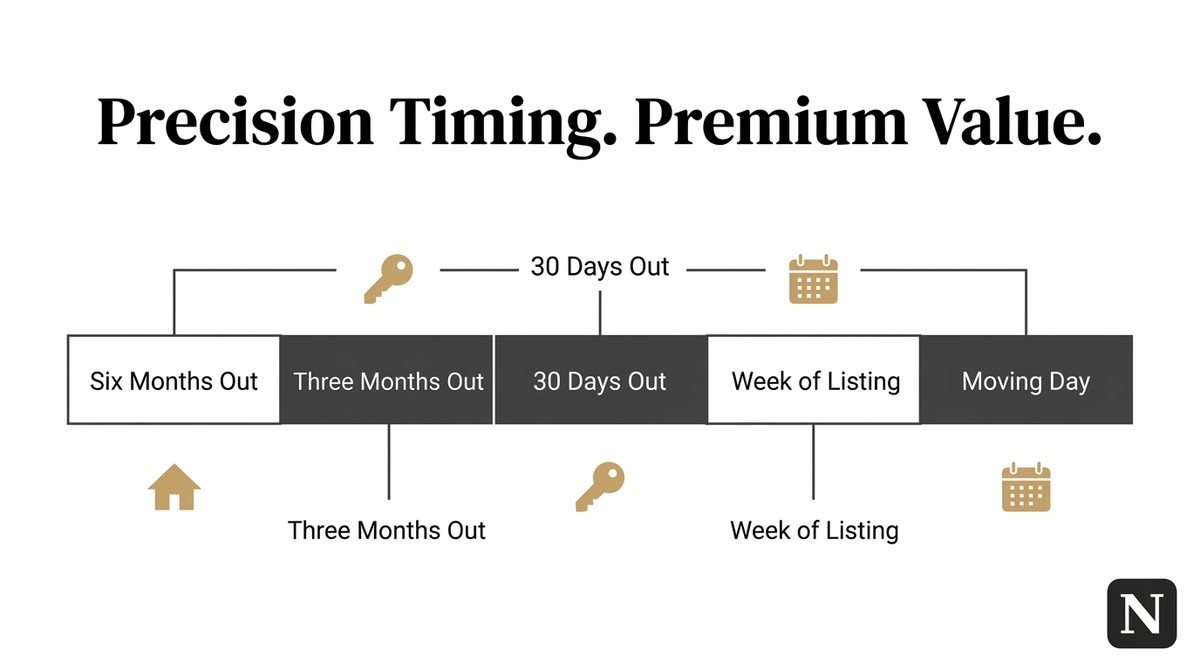
Timeline to Sell South Bay Home: Six-Month Strategic Guide
We observe a recurring pattern in the Silicon Valley real estate market where timing directly impacts final equity yield. When homeowners decide to sell South Bay home properties without adequate preparation, they routinely leave capital on the table due to misaligned market positioning. A structured timeline transforms a chaotic listing into a calculated deployment of a highly valuable asset. We have engineered a highly specific sequence to align property readiness with optimal market absorption rates across Santa Clara County. By adhering to this phase-by-phase framework, sellers maximize their leverage against current inventory constraints and secure premium valuations.
Table of Contents
- Market Mechanics for Silicon Valley Sellers
- Phase One: Six Months Out for Planning
- Phase Two: Three Months Out for Preparations
- Phase Three: Thirty Days to Sell South Bay Home
- Phase Four: Week of Listing Execution
- Phase Five: Moving Day and Transition
- Frequently Asked Questions
Market Mechanics for Silicon Valley Sellers
The local housing market operates on tight schedules dictated by tech-driven wealth, macroeconomic shifts, and RSU liquidity events. Buyers in Santa Clara County expect properties to meet a strict standard of condition before they deploy their hard-earned capital into an investment. Attempting to accelerate this preparation timeline often results in overlooked structural deficiencies or rushed aesthetic choices that fail to resonate with the target demographic. We track absorption rates closely across various micro-markets, and data consistently shows that fully optimized homes spend significantly fewer days on market. For comprehensive details on maximizing returns through calculated improvements, review our guide on preparing South Bay homes for sale.
To successfully navigate these constraints, sellers must understand the strict division of labor across the preparation lifecycle. We organize the process into distinct phases to maintain operational efficiency and protect the final valuation. Key advantages of this phased approach include specific operational and financial benefits.
- Capital Efficiency: Securing contractor bids early prevents paying emergency premiums for rushed repairs.
- Market Timing: Aligning the launch with peak tech liquidity events maximizes buyer purchasing power.
- Risk Mitigation: Discovering title encumbrances or unpermitted additions months before opening escrow.
This structured methodology removes emotion from the equation and treats the property strictly as a financial vehicle. Moving methodically through each phase ensures all stakeholders operate with absolute clarity regarding their specific daily responsibilities. Adhering to this analytical framework is exactly how our clientele consistently outperforms the neighborhood comparable sales metrics.
Phase One: Six Months Out for Planning
At the six-month mark, the objective is macroeconomic assessment and establishing a baseline property evaluation. We initiate a deep analysis of current neighborhood comparables, pending inventory, and upcoming municipal zoning shifts that could impact future valuations. The homeowner owns the responsibility of gathering property records, preliminary title reports, and historical permit documentation for any past renovations. The Norcia Team assumes ownership of forecasting local inventory trends to pinpoint the exact optimal listing week based on seasonal buyer demand. This early operational stage eliminates the friction of discovering unpermitted additions or restrictive title encumbrances during a fast-paced escrow period.
Financial modeling also begins during this foundational period to ensure the net yield meets the seller’s liquidity requirements. Sellers must evaluate tax implications regarding capital gains and the potential for property tax base transfers under current state legislation. We recommend consulting with tax professionals to analyze the mechanics of Proposition 19 if you qualify for tax base portability within California. For an analytical breakdown of these specific transfer mechanisms, see our strategic analysis of Proposition 19. Establishing these fiscal parameters early ensures the final negotiated sale price aligns perfectly with your projected net liquidity goals.
Phase Two: Three Months Out for Preparations
Moving into the three-month window, theoretical planning shifts into physical execution and vendor procurement across the property. We deploy licensed inspectors to conduct comprehensive pre-listing roof, termite, and general property inspections to establish a baseline of condition. Identifying deferred maintenance at this juncture allows homeowners to obtain multiple contractor bids rather than paying extreme premiums for rushed, emergency work. The homeowner takes ownership of initiating the initial decluttering phase and securing off-site storage for excess personal property to maximize spatial perception. Our team manages the coordination of preferred contractors to address the inspection findings systematically, ensuring structural integrity is verified early.
Strategic upgrades are also finalized and commenced during this critical ninety-day window prior to the target launch. We focus capital strictly on improvements that yield a proven return on investment, such as flooring revitalization, modern fixture installation, and precise paint color selections. Upgrades must appeal directly to the prevailing demographic of buyers utilizing tech-sector compensation and RSU vests for their initial down payments. To understand which specific improvements actually drive valuation in our region, consult our resource on home upgrades that enhance lifestyle and value. Completing these physical modifications early prevents unforeseen supply chain issues or construction delays from derailing the target listing date.
Phase Three: Thirty Days to Sell South Bay Home
The thirty-day countdown requires absolute precision in staging, marketing preparation, and statutory legal disclosures. At this critical juncture, all heavy construction, landscaping overhauls, and contractor work must be fully concluded and inspected. We assume complete control of the visual merchandising process, deploying professional staging teams to optimize spatial flow and highlight architectural strengths. The homeowner focuses exclusively on completing the extensive California real estate disclosure packets under our direct supervision and legal guidance. This clear division of labor ensures the property transitions seamlessly from a private residence into a highly marketable financial asset.
Market positioning is solidified during this month based on real-time South Bay inventory data and fluctuating interest rate environments. We finalize the pricing strategy by analyzing the latest pending sales, neighborhood absorption metrics, and direct competitor positioning. Digital marketing assets, including twilight architectural photography and high-fidelity three-dimensional virtual tours, are captured immediately once the physical staging is complete. Nobody should be painting baseboards, fixing minor plumbing issues, or moving boxes during the week these visual assets are scheduled for production. This disciplined operational scheduling is exactly why some properties soar while others sit stagnant on the market for months.
Phase Four: Week of Listing Execution
The final week before going active on the Multiple Listing Service is strictly reserved for marketing syndication and rigorous quality assurance. We conduct a final walkthrough to verify every lightbulb is functioning, every surface is immaculate, and the presentation meets our exact standards. The homeowner completely vacates the premises or establishes a rigid daily cleaning protocol to accommodate immediate, short-notice showing requests from qualified buyers. Our digital infrastructure syndicates the property data across global real estate portals, targeted investor networks, and proprietary brokerage channels. We simultaneously execute pre-market outreach to top-producing local agents to generate immediate, concentrated demand before the public launch.
During this launch week, the pricing strategy is locked and the property is officially exposed to the highly competitive buyer pool. We monitor initial online engagement metrics, virtual tour retention rates, and showing request volume to gauge immediate market reception. The culmination of the previous six months of meticulous preparation manifests directly in the velocity and quality of incoming inquiries. Buyers operating with high RSU liquidity recognize the premium condition of the home immediately upon entry, validating the pricing model. This strategic launch sequence is engineered specifically to compress days on market and force highly competitive, multiple-offer bidding scenarios.
Phase Five: Moving Day and Transition
Moving day represents the logistical conclusion of the physical asset transfer and the final phase of the timeline. By closing day, the homeowner is strictly responsible for ensuring the property is completely vacant, cleared of debris, and broom-clean as required by the purchase contract. We manage the final buyer verification walkthrough to confirm all negotiated repairs were completed to specification and the property condition remains unchanged. Transferring local utility services, canceling existing homeowner insurance policies, and routing mail are the final administrative tasks owned exclusively by the seller. Our operational focus shifts entirely to finalizing the recording of the deed with the county and ensuring the secure, prompt routing of your equity funds.
The successful execution of this phased timeline yields maximum financial leverage and minimal contractual turbulence during the escrow period. By defining clear ownership of critical tasks at each interval, we engineer a smooth transaction devoid of costly last-minute surprises or delays. A highly proactive approach to liquidating real estate assets in Silicon Valley is absolutely non-negotiable for securing top-tier market valuations. We continuously refine these operational phases based on prevailing macroeconomic indicators, interest rate shifts, and regional housing supply data. Adhering to this precise, data-driven methodology is exactly how we secure optimal financial outcomes for our discerning clientele.
Frequently Asked Questions
Why is a six-month timeline necessary in Silicon Valley?
A compressed timeline forces sellers to skip critical pre-listing inspections and strategic aesthetic upgrades that drive higher valuations. Buyers in the South Bay market expect premium conditions to justify the elevated purchase prices inherent to Santa Clara County. Taking six full months allows for calculated capital deployment on necessary repairs rather than paying exorbitant emergency rates for expedited contractor availability. It also provides adequate time to resolve complex title issues, unpermitted structures, or boundary disputes long before buyers enter the equation.
Who handles the coordination of pre-listing repairs?
The Norcia Team takes complete ownership of sourcing, scheduling, and overseeing our extensive network of vetted local contractors. While the homeowner finances the necessary structural and aesthetic improvements, we remove the massive operational burden of managing the daily construction schedule. This hands-on management ensures all required work is completed precisely thirty days prior to the target launch date without fail. Maintaining this strict construction schedule prevents any costly interference with our professional staging installations and architectural photography sessions.
How does tech-driven wealth impact the listing strategy?
Buyers utilizing restricted stock units and performance bonuses for their down payments are highly sensitive to market timing and interest rate fluctuations. We strategically align the listing launch with historical peaks in local tech liquidity events to maximize total buyer purchasing power. Understanding these specific macroeconomic wealth trends allows us to price the home aggressively yet realistically within the current financial climate. The extended six-month runway gives us the necessary flexibility to shift the final launch week based on real-time tech sector data.
When should homeowners complete real estate disclosures?
We strictly mandate that sellers complete all statutory disclosure documents during the critical thirty-day window prior to the official listing launch. Completing these extensive legal forms early provides prospective buyers with a comprehensive, transparent view of the property upfront before they submit offers. This radical transparency significantly reduces the probability of aggressive renegotiations, buyer remorse, or canceled contracts during the sensitive escrow period. Our experienced team guides sellers through the complex paperwork line by line to ensure absolute compliance with all California real estate laws.
Posted on October 3, 2026 by The Norcia Team in Uncategorized
← Back to Blog