
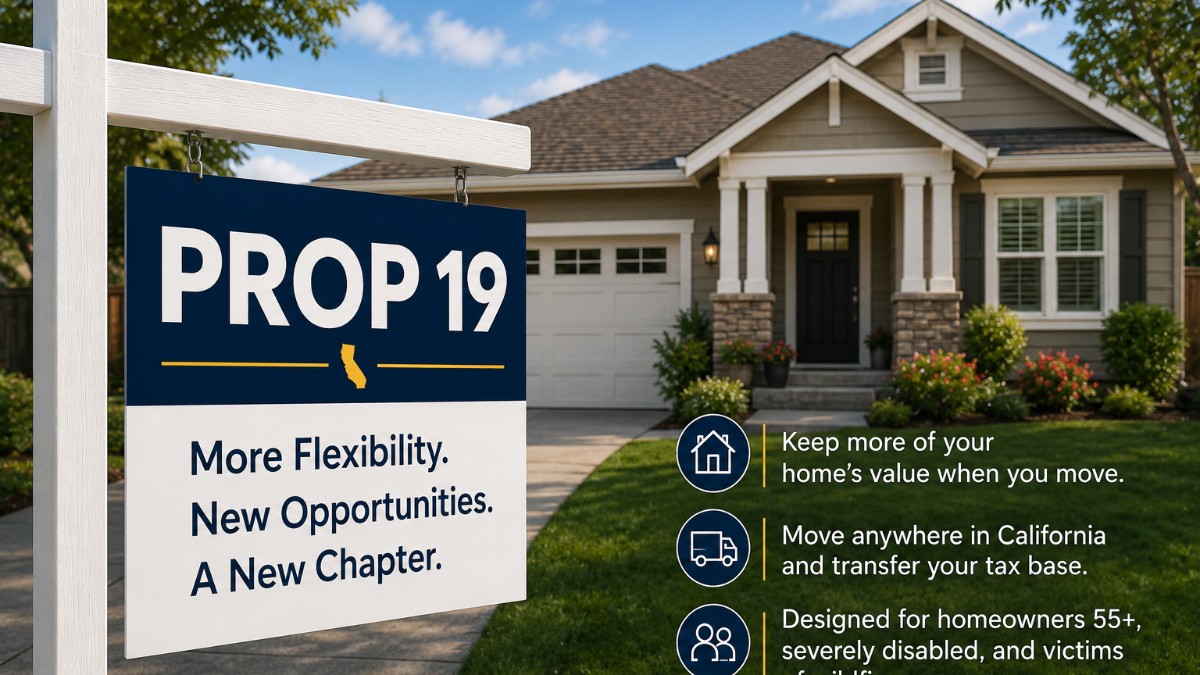
The Silicon Valley real estate market operates under unique financial mechanics, driven by decades of compounded equity and tech-driven wealth. For property owners aged 55 and older, the decision to liquidate a long-held asset in Santa Clara County is often dictated by tax implications rather than simple inventory constraints. Proposition 19 fundamentally alters this calculus. By allowing the transfer of a highly favorable property tax base to a replacement primary residence, this legislation provides critical leverage for sellers looking to optimize their real estate portfolios without incurring punitive tax reassessments.
The Mechanics of Proposition 19 in Santa Clara County
Prior to recent legislative shifts, tax base transfers were limited by county lines and strict price ceilings. Today, the framework is significantly more expansive. Homeowners 55 and older can transfer their original Proposition 13 tax base to a new property anywhere in California up to three times. In high-appreciation zones like Los Gatos or Campbell, where a property acquired in 1995 for $400,000 commands a current market valuation exceeding $2.5 million, the preservation of the original tax assessment yields substantial annual capital retention.
Financial Benefits and Valuation Metrics
We track the direct financial impact of these transfers on seller net sheets. The strategic advantages include specific, measurable outcomes:
- Value Flexibility: Sellers can purchase a replacement property of equal or lesser value and retain their exact current tax base.
- Upward Mobility Adjustments: If the replacement property exceeds the sale price of the original home, the tax base is adjusted upward only by the difference in price, avoiding a full market-rate reassessment.
- Geographic Liquidity: The removal of inter-county restrictions allows South Bay sellers to liquidate high-value assets and deploy capital across the state while maintaining their tax advantage.
Legal Requirements and Execution Strategy
Executing a Proposition 19 transfer requires strict adherence to statutory timelines and documentation. The replacement property must be purchased or newly constructed within two years of the sale of the original primary residence. Furthermore, the claim must be filed with the county assessor alongside specific documentation verifying age and primary residency status. Miscalculating absorption rates or days on market can jeopardize this two-year window. We analyze local inventory data to time these dual transactions, ensuring our clients maintain continuous market exposure without risking their tax transfer eligibility.
Optimizing Equity in a Constrained Market
Navigating the intersection of Proposition 19 tax benefits and Silicon Valley housing inventory requires precise market timing. In a market heavily influenced by RSU liquidity and tech-driven wealth, older sellers often face competing buyers with significant cash reserves. Utilizing Proposition 19 allows long-term owners to unlock their trapped equity and compete effectively in replacement markets. Sellers must evaluate current absorption rates in their target replacement markets against the liquidity of their existing asset. We provide the analytical framework necessary to execute these complex transitions.
To review a detailed analysis of how Proposition 19 applies to your specific property valuation, Contact Us at The Norcia Team or call (408) 823-2022.
Posted on May 7, 2026 by The Norcia Team in Uncategorized
← Back to Blog